
UXBeacon — Automated UX Audit Tool
A free, no-login tool that scores any public website's UX across heuristics, accessibility, content and UX-law compliance in seconds.
Context
Most quick UX-audit tools either require a login and a sales conversation, or they return an AI-generated score with no visibility into how it was calculated. UXBeacon set out to be the opposite: free, instant, and built entirely on rules a designer could actually inspect and argue with.
The Challenge
The product needed to analyse a real website — crawling multiple pages — and turn that into a single trustworthy score, fast enough to feel instant, without hiding behind an opaque AI model or a sign-up wall.
Research
Grounded every scoring engine in an established, citable framework — Nielsen's heuristics, WCAG 2.2, classic UX laws — specifically so the tool's output could be traced back to a rule, not a black-box model's opinion.
Insights
The key findings that shaped the direction.
Designers don't trust scores they can't trace
A score is only useful if you can ask 'why' and get a concrete rule as the answer — deterministic, rule-based scoring builds more trust than a higher-sounding AI score.
No login is a feature, not a compromise
Removing the sign-up step wasn't just about lower friction — it changed how the tool got used, as a quick sanity-check rather than a formal audit process.
One score isn't enough, but five is too many to act on
A single composite score is useful for a first read, but only broken into heuristics, accessibility, content and UX-law categories does it tell you where to actually start fixing.
Design Strategy
How decisions were made.
Build on citable rules, not a model
Implemented each analysis engine — heuristics, accessibility, content, UX laws — as a deterministic rule set that produces the same score for the same input every time.
Remove every barrier to a first scan
Required no account and no setup — just a URL — so trying the tool costs nothing more than typing a website address.
Score in layers
Combined five category scores into one weighted A–F health score, so the tool answers both 'how good is this site' and 'good at what, specifically.'
Make results portable
Built PDF, CSV and JSON export from the start, since a UX audit is rarely useful only inside the tool that generated it.
Direct AI at the build, not the judgement
Used Claude Code as a development partner to implement six parallel analysis engines and a full crawler, while every rule the engines score against was specified and reviewed by hand — deterministic scoring depends on it.
Solution
A free, login-free UX audit tool that crawls up to 25 pages of a site and runs six deterministic analysis engines in parallel, producing a transparent, exportable health score.
A look at the work.
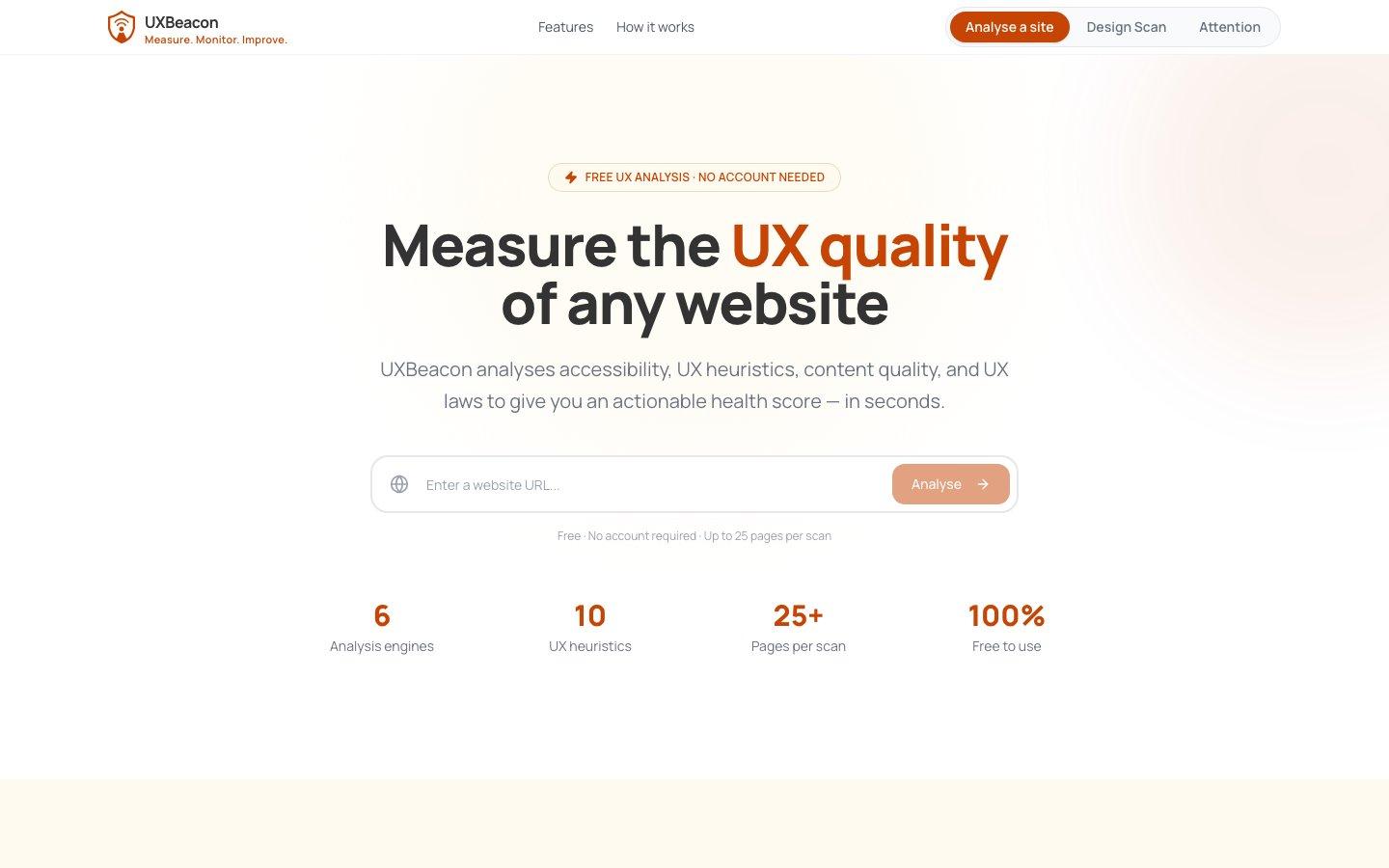
The live product at uxbeacon.vercel.app.
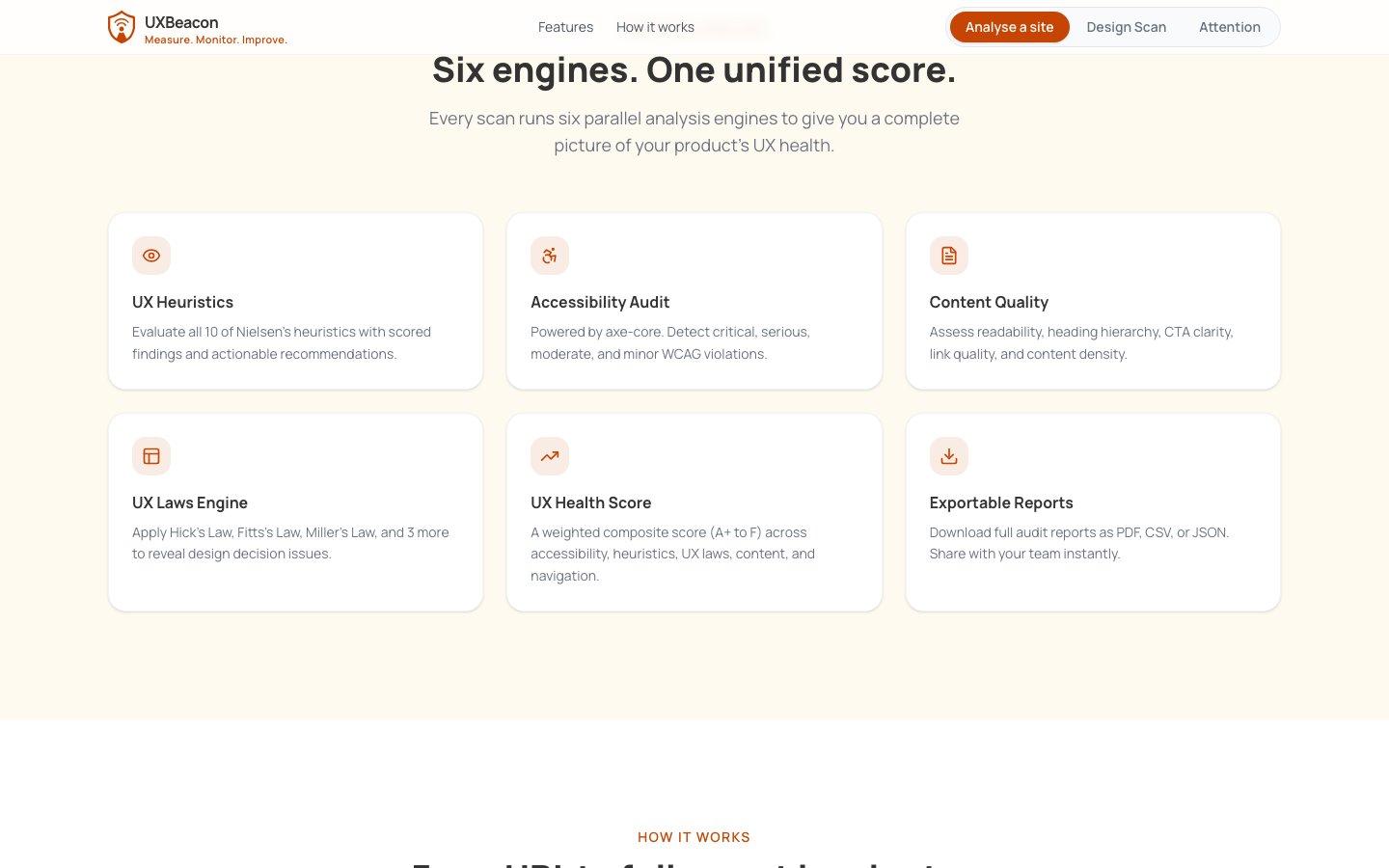
The six parallel engines behind every scan — heuristics, accessibility, content, UX laws and more.
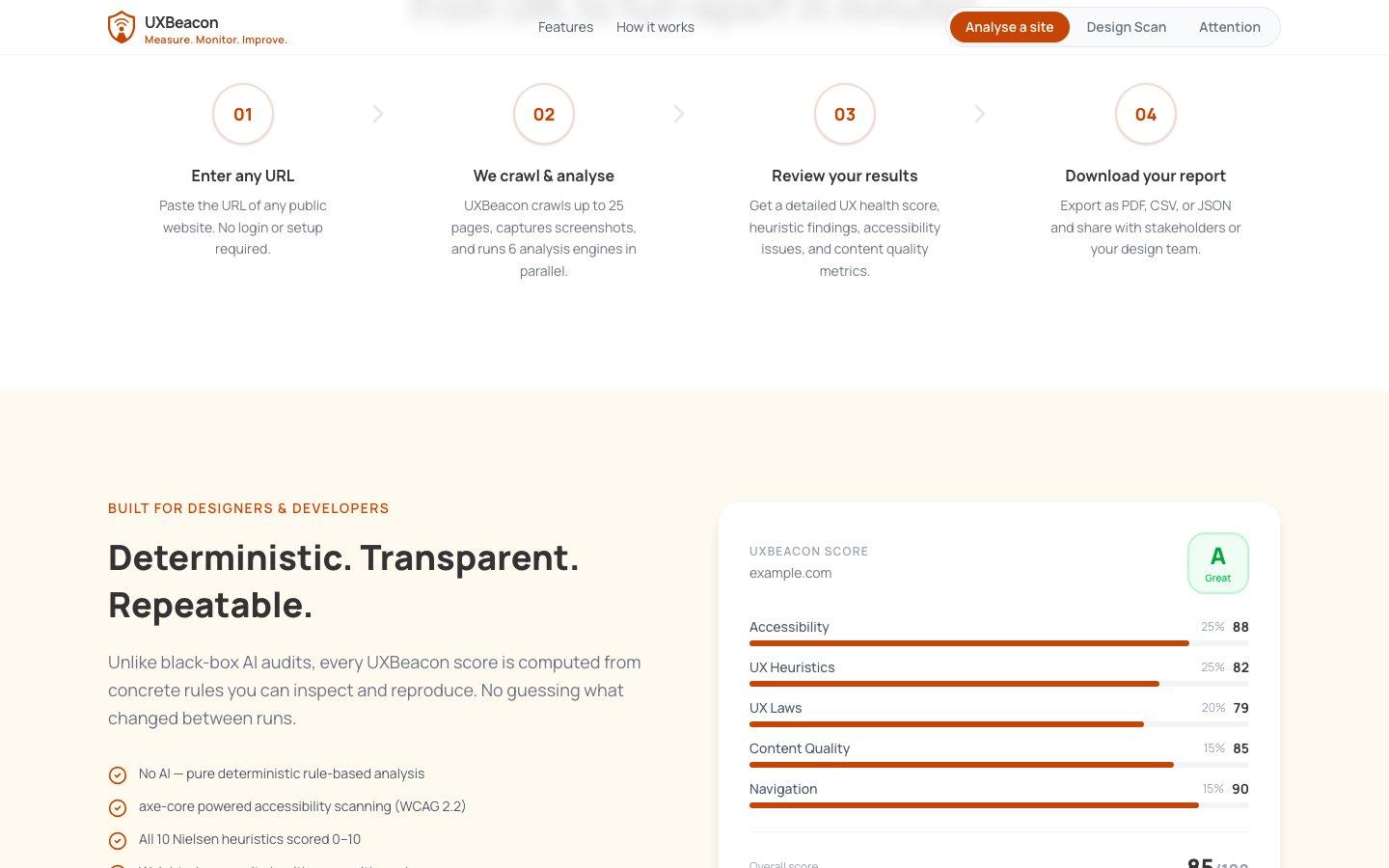
A sample scan result — an A–F grade with a transparent, per-category breakdown.
Design System Thinking
This project wasn't designed as a one-off — here's how it connects back to the system.
Components
A shared score-card component reused across all six engines and the composite health-score summary.
Tokens
An A–F grading scale with consistent colour coding applied across every category and the composite score.
Patterns
A crawl-then-score pattern that runs all six engines in parallel against the same page set, rather than sequential single-page checks.
Governance
Every score traces back to a specific, inspectable rule — no engine outputs a number without a documented reason.
Impact
UXBeacon shipped as a free, instant alternative to sales-gated audit tools, giving any designer or developer a reproducible UX health score for a site in seconds.
Reflection
Choosing deterministic rules over an AI model was the harder, slower path to build — every rule had to be defined and justified by hand. But it's also the reason someone can actually trust and act on the score, which was the entire point of the tool.